|
Providing the Ultimate Solutions in Precision Displacement Sensors
|
Order • About • Site Map |
|
||||||||
Position Measurement & Control - December 1999 (S050-1) |
|
Position Measurement & Control is published for the customers of Firstmark Controls and the engineering and instrumentation community. Subscriptions are free. To subscribe at no charge, submit a Newsletter Subscription Request. Contents
Cal Poly University Rose Parade Float Stolen Time On January 1, 2000, the Cal Poly University Rose Parade float will move along Colorado Boulevard, watched by 1 million street spectators and a television audience of approximately 450 million people. On board, Firstmark Controls position transducers will be providing feedback to onboard computers that will control the float's animation sequences.
Cal Poly University, with two campuses located 240 miles apart in Pomona and San Luis Obispo, California, USA is renowned for its engineering, scientific, and agricultural programs. Cal Poly has participated in every Rose Parade since 1951, the longest continuous participation by any Rose Parade float builder. Competing against professional float builders who manufacture entries for their sponsors, Cal Poly has continued to win awards against floats with development budgets approaching $1 million. The Cal Poly team begins its activities in January of each year by tearing down the prior Rose Parade float, re-using components as much as possible. In February, a design theme is selected from student entries and, in June, physical construction of the float begins. This construction continues independently at each campus until Thanksgiving when the Cal Poly San Luis Obispo module is transported 240 miles by flatbed truck to Cal Poly Pomona for joining. After the second week of December, work on the float continues on a 24/7 basis until the day of the parade. Around December 21st, the float is towed with police escort to Pasadena, California, a 3- to 8-hour journey depending on the floats design, traffic conditions, and unforeseen problems. At this stage, the float is nearly complete with the exception of the application of paint, flowers, and other natural decorating materials. A unique aspect of every Cal Poly float is that many of the flowers used to decorate the float are grown by Cal Poly horticulture students. Cal Poly floats are best known for their quality in humor and animation. With a theme of "Stolen Time," this year's entry is no exception. Featuring a Tyrannosaurus Rex stealing a mad scientist's Time Machine and being chased by two Time Police air vehicles, "Stolen Time" will highlight a number of state-of-the-art float technologies including hydraulic, pneumatic, and electrical actuation; PLC control; smoke machines; and environment-friendly propane power. This year's entry will be the first Rose Parade float that will have computer-controlled animation by way of an Allen-Bradley PLC (programmable logic controller) and Wonderware process automation software. Developed from the efforts of 50 Cal Poly students, "Stolen Time" has an estimated value of $250,000 if developed by a commercial float builder. "Stolen Time" is about 54 feet in length and features 2 propane-powered, inline-6 engines to power its drivetrain and hydraulics systems. During the parade, the float is managed by a staff of six personnel: 1 driver, 1 observer, 2 electronics monitors, and 2 hydraulics monitors. Also on board are two gasoline-powered DC generators to power the audio and PLC/animation systems. Two smoke machines are also in place to give the appearance of hovering Time Police. For the animation, the float features 12 hydraulic cylinders, 2 hydraulic motors, and 2 electrical motors.
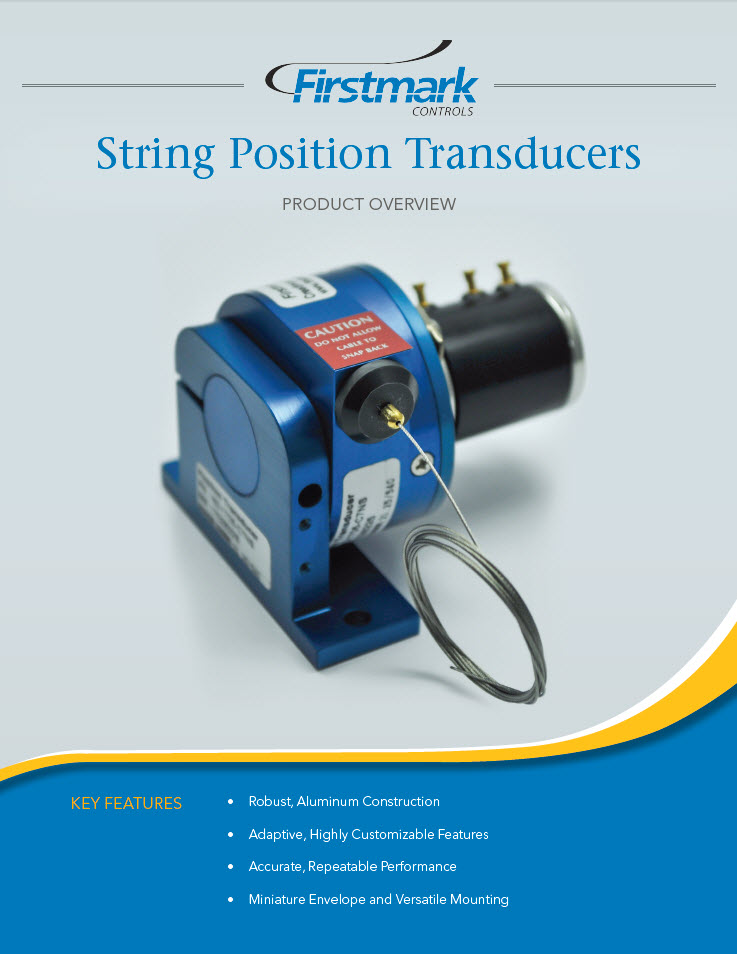
Firstmark Controls Series 160 and 161 position transducers are used in 10 locations on the float to provide position feedback on a number of components including the Time Police and the T-Rex's tail, neck, and jaw. The transducers were powered with 10 volts DC with electrical cabling taken from the transducers to the PLC and an animation computer via a transfer box. No signal conditioning was required. The PLC converted the analog transducer signals to a 12-bit digital representation using a sampling rate of 100 samples per second. Summarizing their experience with Firstmark Controls position transducers, Ben Barker, assistant electronics lead at Cal Poly Pomona commented, "A lot of past alumni from the rose float commented on how small the transducers were compared to the ones they used in the past. They were also nice because they already had adjustable mounts on them which came in handy."
More information on the Cal Poly Rose Parade float can be found at http://www.csupomona.edu/~rose_float/ Application Corner The Application Corner is dedicated to answering your questions about using position transducers in specific applications. If you have an application question you would like answered, please let us know by phone, fax, e-mail, or mail. Catenary CurveQ. How does the force of gravity and the resulting cable sag affect the accuracy of your position transducers? A. A catenary curve describes the shape the displacement cable takes when subjected to a uniform force such as gravity. This curve is the shape of a perfectly flexible chain suspended by its ends and acted on by gravity. Its equation was obtained by Leibniz, Huygens, and Johann Bernoulli in 1691. Because the mass of the cable per unit length is so small and the cable tension is relatively high, cable sag does not produce any significant error and this error source is minor compared to other error sources. For more information on errors due to displacement cable sag, see our Catenary Curve Calculator at calccabl.htm. Calibration ProceduresQ. What method do you use to calibrate your position transducers? A. Firstmark Controls standard analog (precision potentiometer) position transducers are calibrated upon customer request prior to shipment. Our standard calibration and test report or Acceptance Test Data Sheet (ATDS) provides 10 points of displacement and cable tension data with a 5 VDC excitation. Data and calculated values are provided in English and SI units. ![]() The independent linearity calculation for these products is in accordance with VCRI-P-100A (Industry Standard - Precision Potentiometers) published by the Variable Electronics Components Institute (P.O. Box 1070, Vista, CA 92085-1070 USA, +619-727-3011, +619-727-6555 (fax), vrci@aol.com, http://www.veci-vrci.com/). This document defines independent linearity as "the maximum deviation of the actual function characteristics from a straight reference line with its slope and position chosen to minimize the maximum deviations." For more information on our acceptance test procedures and data sheet, contact our Quality Control group at info@Firstmarkcontrols.com. We also have an online linearity calculator. Idler and Cable RangeQ.I am using a Model 160-0803 with the idler cable exit. Why can I only get around 9.25 inches (235 mm) of travel instead of the 10 inches (254 mm) the unit is rated at? A. Because the cable stop must go past the idler drum, you will not be able to use the first 0.75 inches (19 mm) of travel. If your application requires the extra travel, either order a unit with slightly longer range or request a unit with a temporary cable stop (split shot: 3/16", part number 300361) that can be removed after installation. How to Improve ResolutionQ. I am not getting the resolution I expected to get from your product? Can you make some recommendations on how to improve my results? A. Our standard analog-output position transducers use precision hybrid or conductive plastic potentiometers. These types of potentiometers output an infinite signal when properly used. However, your effective resolution will be limited by system noise and the resolution of your data acquisition system. As an illustration, if your data acquisition has negligible noise and a resolution of ±1 mV, you could expect to see resolution as good as ±0.025 mm for a Model 150-0121 position transducer (38.1 mm maximum range) with 10 VDC excitation. Effective resolution should increase for higher excitation voltages. Do not exceed the power rating of the position transducer (for the Model 150-0121, 0.75 W which equates to a maximum excitation of 61 V using the position transducer in a pure voltage divider circuit). If you are not achieving that level of resolution, you may want to review the accuracy of your data acquisition system and such factors as sampling rate, signal conditioning, averaging integration, white noise, EMF interference, and characteristic impedance. If you have a high-resolution, low-noise data acquisition system, you may still have problems verifying the resolution unless you are using a high-resolution measuring device such as a positioning slide with a stepper motor. We have such a system at our test facility and can verify resolutions to within ±0.025 mm at a 10 VDC excitation. This is a good technique but remember that there is backlash in the worm gears. This will affect the observed repeatability by as much as ±0.15 mm. This might also affect your resolution if you change direction during the test (hysteresis). In other words, you may see no apparent change in the output of the unit when changing direction from cable extraction to cable retraction due to backlash in the test system. To detect this, you may want to use a high-resolution optical encoder to verify position.
ISSN 1527-5108 |
|
Firstmark Controls • info@Firstmarkcontrols.com |
Business hours: Mon-Fri, 8:00am to 5:00pm (Eastern time) All specifications subject to change without notice. © 1996-2008 Firstmark Controls All rights reserved. |
| top | Newsletter • News • Representatives • Request Literature • CAD Models • Calculators | top |